break
Click on the song titles above for lyrics and songwriting credits

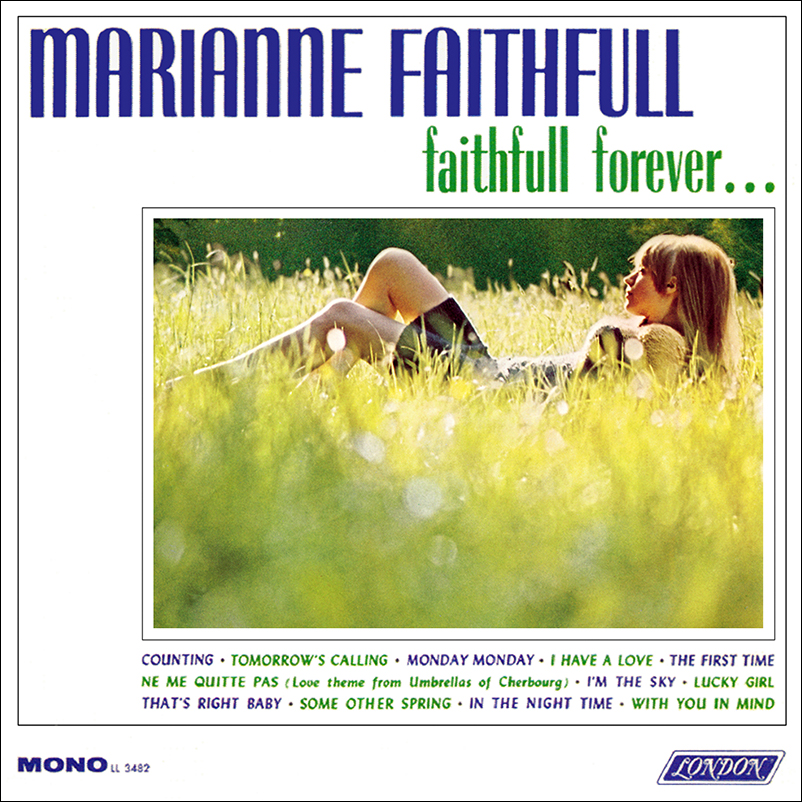
Faithfull Forever is a unique release in Marianne’s discography in that it only ever came out in America. While London Recordings, the US arm of Decca Records, would release all her albums under different titles and configurations, this LP remains the only one to include songs not released elsewhere. Perhaps because some of the tracks appeared eight months later on Marianne’s 1967 UK LP Loveinamist, Faithfull Forever has often been written off as a compilation when in fact it deserves to be considered as an album in its own right: it features six exclusive recordings, has a specially commissioned cover shoot by Jean Marie-Perier and Marianne chose an extract from the poem ‘La Belle Dame Sans Merci’ by John Keats in place of the usual back cover liner notes; this is a sure sign of the album’s authenticity, as her love of the 19th century romantic poets was already well known and 55 years later she would record the poem for her 2021 spoken word album She Walks In Beauty.

Faithfull Forever opens with two tracks that define the album’s folky romanticism. A cover of ‘Counting’ composed by the singer, songwriter and author Bob Lind, and ‘Tomorrow’s Calling’, written for her by the Scottish songwriter and session musician Eric Woolfson (later of the Alan Parson’s project). Although it was only a minor hit at home, this was another track perfectly tailored to Marianne’s interpretive gifts and she maintains quite rightly that it is one of her best 60s pop recordings. Both tracks were released on a single in the US a month before the album came out. ‘The First Time Ever I Saw Your Face’ was written by the British political singer-songwriter Ewan MacColl for Peggy Seeger, who later became his wife, and it was their 1962 version that Marianne had in her record collection. Her interpretation initially appeared in a more traditional folk arrangement four months earlier on North Country Maid but perhaps sensing that it had crossover appeal it was now remixed by Mike Leander with added instrumentation and choral parts performed by the Royal College of Music.

‘With You In Mind’ is another recording that demonstrates just how far Marianne’s vocal technique had come. Recorded for an abandoned UK single, the song features complex harmonies that reflect a singer now in total command of her voice and able to deploy it to maximum effect. Written by Jackie DeShannon and originally recorded by the American gospel-folk duo Joe and Eddie, Marianne turns the gospel country sound of the original into a ravishing folk-pop ballad. Marianne was an acknowledged Donovan fan and would successfully cover five of his songs. ‘In The Night Time’ or ‘Hampstead Incident’ as Donovan later called it fits perfectly with the slightly trippy folk imagery found elsewhere on the LP and it shows once again just how well his material suited her. It’s also not widely known that Marianne’s recording came out six months before Donovan’s version on Mellow Yellow. Popularised in English as ‘I Will Wait For You’, ‘Ne Me Quitte Pas’ is from the 1964 French musical Les Parapluies de Cherbourg. Michel Legrand’s memorable score helped turn the film into an international hit and Marianne wanted to record the love theme. The song originally appeared on a French EP alongside ‘Si Demain’, her French recording of ‘Tomorrow’s Calling’.

The second side of the album opens with ‘Monday, Monday’ and reinforces Marianne’s ability to pull off some unexpected song choices. Although a segue into American sunshine pop does not immediately sound like a natural transition, her version of The Mamas And The Papas classic works surprisingly well. This is followed by Marianne’s foray into jazz on the Herzog Jr/Kitchins standard ‘Some Other Spring’ which will be a revelation to those who know her only as a singer of folk-pop. Aside from producing and arranging Marianne’s recordings, Mike Leander would intermittently write her a song: ‘That’s Right Baby’ was issued in the UK as the B-side to ‘Tomorrow’s Calling’ under his pseudonym Michael George Farr. Finding pop material suitable for Marianne would often prove a challenge and the most successful results were usually culled from contemporary writers with a folk sensibility. ‘I’m The Sky’ was written by Norma Tanega and would subsequently appear on her debut album Walkin’ My Cat Named Dog. Recorded at the same session as ‘Some Other Spring’, the Sondheim /Bernstein composition ‘I Have A Love’ was another of Marianne’s ambitious song choices that would take her out of her comfort zone. “I liked a lot of those big musicals, and I had been to see the West End production of West Side Story and really wanted to give this a go.”

Faithfull Forever was released in August 1966, with a UK release originally scheduled for September, but the release was delayed as Marianne wanted to record further tracks from Donovan and Jackie DeShannon, the songwriters she thought suited her best; she had also recently discovered the work of Tim Hardin. Eventually five of Faithfull Forever’s 12 tracks (although ‘Counting’ is a different version to the US release,) would be released on Marianne’s next UK pop album Loveinamist in March 1967. In April 2024 Faithfull Forever made its UK debut, when it was remastered by Andrew Batt and released on clear vinyl with new artwork for Record Store Day